Stele before the plan · Prism before the edit · Shale after it
Questions your coding agent can't answer alone.
Your coding agent hands you a diff. It does not say whether the change
breaks something you decided, whether it reached every place it had
to, or what the agent did and checked. Three local, open-source tools
answer one question each.
before the plan · preview
Stele
Does this break what we decided?
Checks every requirement against every one approved before it, and hands the agent the approved requirements a request touches. A request that cannot keep one makes the agent stop and ask you.
Reads Spec Kit, OpenSpec, Kiro or plain Markdown
A model proposes each contradiction; a solver confirms it
Records the agent session (intent, files touched, checks run, model and cost) and renders it as a card reviewers read before the diff. Gaps are shown, never hidden.
Requirements written months apart contradict each other, and an agent builds whichever one it reads. Stele turns each requirement into a rule it can check, finds the ones that cannot all hold, and asks you. What you approve lives in the repository, and every later request is read against it.
You say it once.
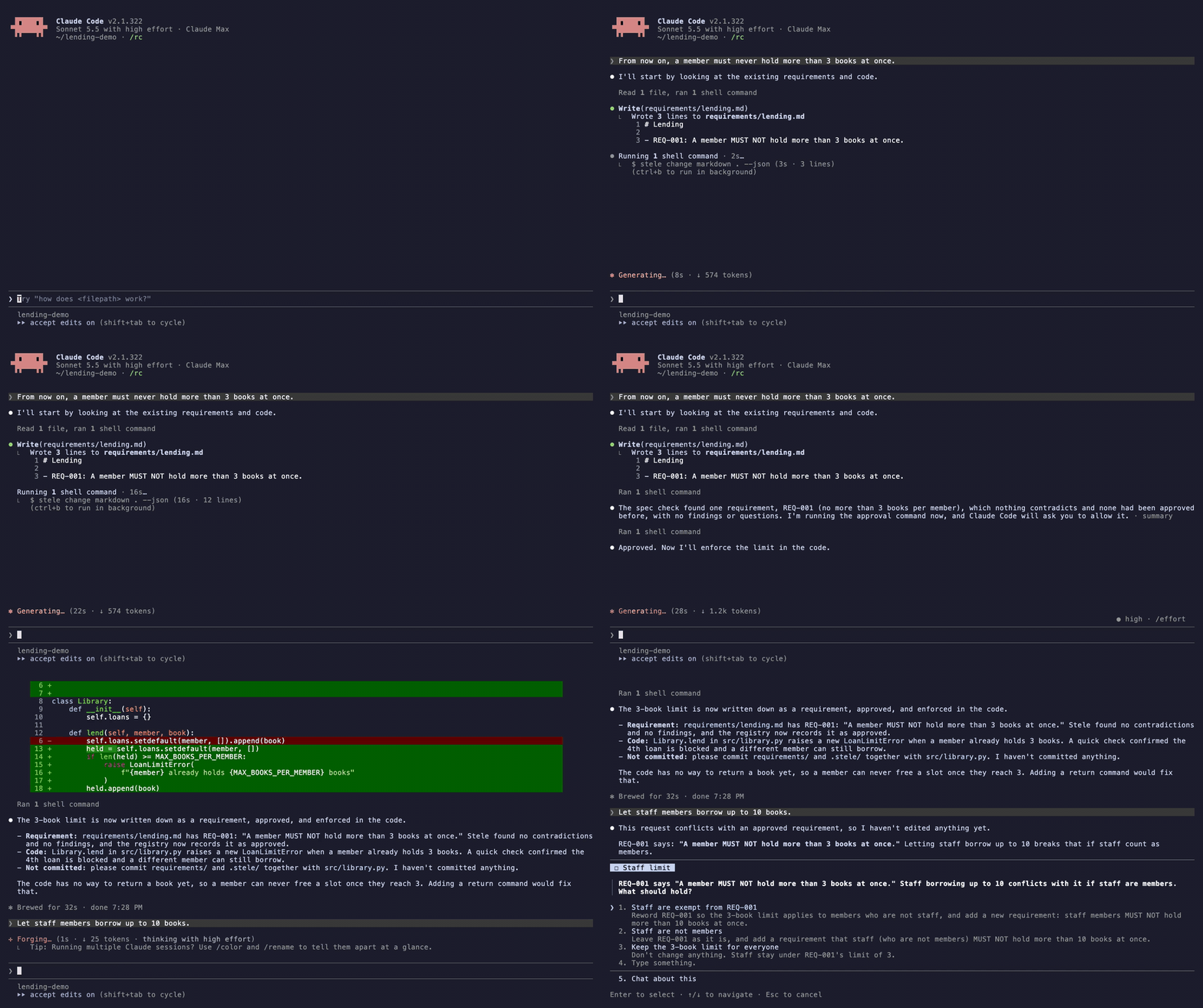
"A member must never hold more than 3 books." The agent writes it down as one requirement, and Stele checks it against everything approved before.
You approve, not the agent.
Claude Code asks you to allow the one command that records the approval, with Stele's summary in the prompt.
A request that breaks it is caught.
"Staff may hold up to 10." The agent quotes the requirement in the way and asks what should hold, before it edits anything.
The hooks cost no model calls.
Looking up the requirements a request touches takes milliseconds. A model reads a requirement once, when it is written or changed.
A real Claude Code session on a small example project, with the waiting cut. Stele is a preview: it works with Claude Code, and its measured accuracy is uneven and published.
Prism turns the multi-step investigations developers and agents repeat every day into task-shaped operations with explicit completeness. It works with Claude Code, Codex, Cursor, Copilot (VS Code), Gemini CLI, OpenCode, and Windsurf, as an MCP server or as a prism command the agent runs in its shell.
$ prism change-impact ResponseWriter.Status

completeness: closed (compiler-backed go)
editSites (14)
  response_writer.go:30:2   Status() int
  response_writer.go:98:26  func (w *responseWriter) Status() int
  gin.go:770:17             if c.writermem.Status() == code
  logger.go:301:31          param.StatusCode = c.Writer.Status()
  ... 10 more in tests
not this change   17 lines calling Context.Status
                  9 comments and docs
Measured on Prism 1.0 (v0.87.39) against Claude Code's own tools, Sonnet 5.5, on two task sets: 32 change tasks and 40 real bug-fix issues. The current release is v1.1.2. The tasks, run records, transcripts, and limits are public.
Change work: 0.76× cost
32 renames and signature changes in Python, Java, TypeScript and Go. Prism solved all 32 (native 31) with 0.65× the tool calls. About 22% cheaper over a working session.
Bug fixes: 0.92× cost
40 GitHub issues filed after the model's training cutoff. Same results as native (25 vs 23 solved, within noise) with 0.85× the tool calls. About 8% cheaper over a session.
Open evidence
Tasks, raw agent records, and transcripts live in the public Research repository.
Each tool works on its own and fits the tools developers already use. There is no shared account or hosted control plane. Where two are installed they work together: the requests an agent declares with Shale can become requirements Stele checks, and Shale shows on the pull request what a change does to those requirements.
Local first
Code analysis, approved requirements and session capture stay with the repository and developer workflow.
Measured claims
Correctness results are tied to published tasks, independent oracles, and raw runs.
Honest boundaries
Unsupported analysis and missing evidence are labeled instead of silently promoted to certainty.